Badedermatitis in Europe
Cercarial dermatitis – popularly known as bathing dermatitis, duck schistosomiasis or regionally “weiherhibbel” – is an itchy, allergy-related skin inflammation that can occur after swimming in fresh water. The triggers are larvae (cercariae) of flukes of the genus Trichobilharzia, so-called bird bilharzia. These parasites actually specialize in waterfowl and freshwater snails; Humans are a “bad host” in which the parasite cannot survive. The cercariae accidentally burrow into human skin, die there and trigger an allergic reaction. The disease is usually harmless and heals within about one to three weeks without any consequences. In Germany and large parts of Europe, it is considered a recurring phenomenon at many bathing lakes in warm summers.

Your free account
Save interesting articles, track your reading progress and connect with other readers. Joining Pandragora is free.
Discover more with Premium
Start a subscription to get unlimited access to all articles.
Cercarial dermatitis is a waterborne, non-contagious skin disease. It occurs when free-swimming larval stages (cercariae) of leech-related flukes of the family Schistosomatidae penetrate human skin. The disease was first scientifically described in 1928 by the American parasitologist W. W. Cort. Since these worms do not use humans as their final host, they cannot develop further within them - the larvae are recognized and destroyed by the immune system, which causes the typical, extremely itchy skin changes.
Humans become infected purely by chance and “accidentally”. The disease cannot be transmitted from person to person. In Europe, cercarial dermatitis is the most common waterborne parasitic skin reaction during recreational swimming and is increasingly considered to be an emerging zoonosis.
The pathogen and its life cycle
The hosts involved
The life cycle of Trichobilharzia usually takes place between two hosts: freshwater snails serve as intermediate hosts, and water birds - especially ducks, geese and swans - serve as definitive hosts. In Europe, snails of the genus Radix (e.g. B. Radix auricularia) and Lymnaea significant. Humans do not fit into this system - they are a false or accidental host in which the cycle breaks off.
From egg to cercaria
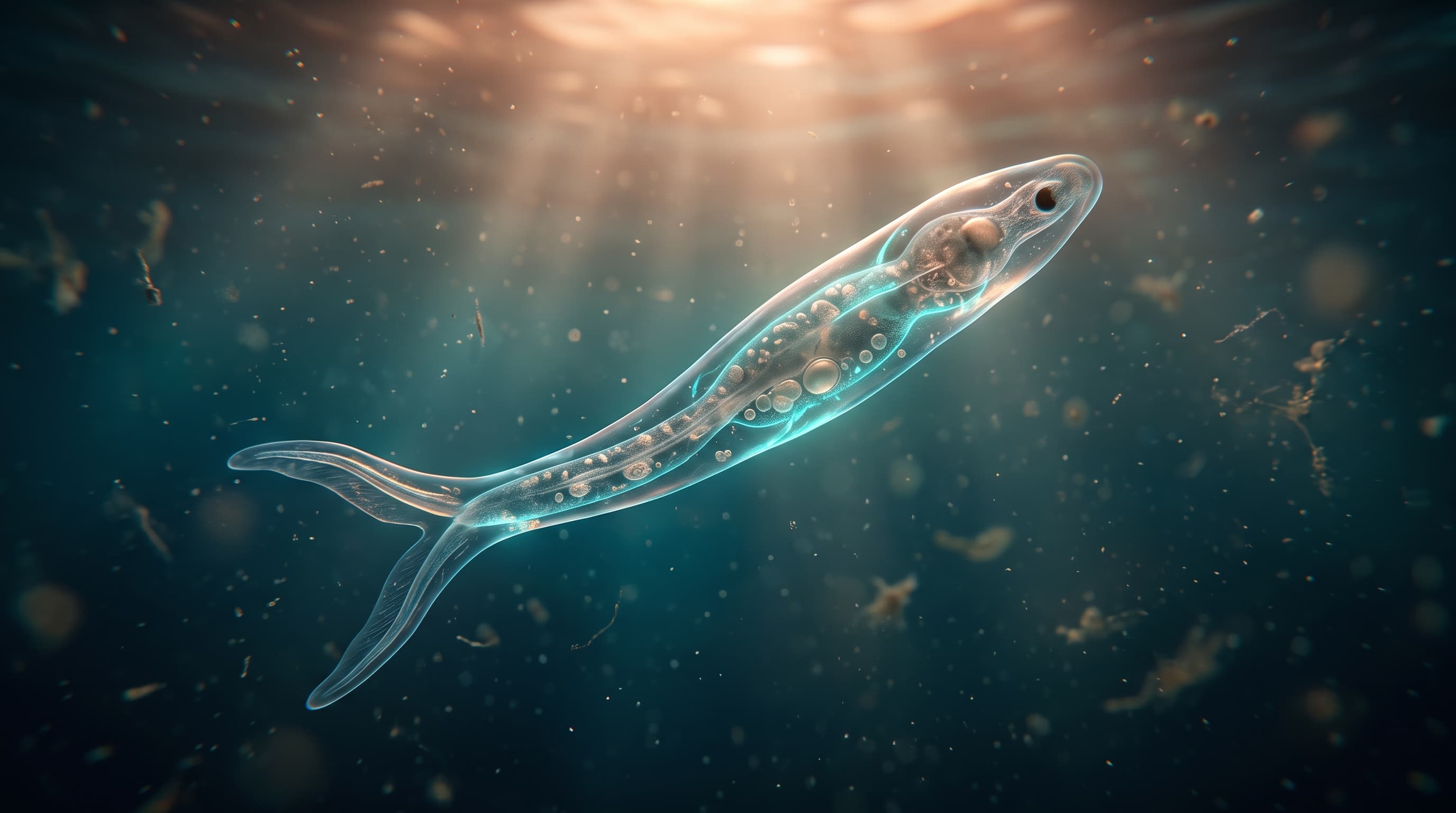
The cycle begins with the worm's eggs, which enter the water via the feces of infected waterfowl. A tiny, ciliated and free-swimming larva, the miracidium (ciliate larva), hatches from the egg. It follows chemical and physical stimuli until it finds a suitable snail and penetrates it. The parasite continues to develop asexually in the snail: daughter sporocysts arise from a mother sporocyst, which in turn produce a large number of the actual infection larvae - the cercariae. These cercariae have a characteristic forked tail (fork-tailed larvae, “furcocercariae”).
The mature cercariae leave the snail and actively swim to the surface of the water, where they search for a water bird using chemical and physical stimuli. If they find him, they drill through his skin. In the bird they mature into adult worms that live in the blood vessels and produce new eggs - the circle closes. To penetrate the skin, the cercariae use special enzymes (cysteine peptidases) that dissolve keratin and collagen in the skin.
When humans come into play
If a cercaria mistakes a bathing human for its actual bird host, it burrows into human skin. However, their path ends there: the human immune system recognizes and destroys the intruder. Each individual itchy wheal corresponds to the immune reaction to a single invading larva. The parasite dies in the skin and cannot cause disease inside the body - the reaction remains locally limited to the skin.
One exception with a question mark: the species Trichobilharzia regenti (first described in the Czech Republic in 1998) is neurotrophic. In experimental animals, it can partially escape the early immune response, penetrate nerve tracts and travel to the spinal cord, where it triggers inflammation. Whether and to what extent this poses a risk to humans has not yet been conclusively clarified scientifically; A possible risk factor is being discussed, especially for immunocompromised people. There is now evidence of this kind. a. from Denmark and Belgium.
Why just a few infected snails are enough
The proportion of infected snails in a body of water is usually low - studies have found infestation rates of often less than 1 to around 3 percent (e.g. B. around 0.6–3.0% at Baldeneysee on the Ruhr). Nevertheless, this is enough to pose a noticeable risk, because a single infected snail expels enormous quantities of larvae. Laboratory experiments with Trichobilharzia szidati in the mud snail Lymnaea stagnalis revealed an average of around 2,621 cercariae per day per snail, with peaks up to around 29,560 on a single day. Over their lifetime, this adds up to a larval mass that equals or exceeds the snail's body weight.
Symptoms and course
How strong the reaction is depends largely on whether the body is already aware of the parasite. At the very first contact, the infection is often symptomless or very mild - occasionally those affected notice a slight tingling sensation, a mild itching of the skin or redness at the entry point a few minutes after contact. However, the body becomes sensitized.
Upon further, repeated contact, the now sensitized immune system reacts much more violently. Typically, a few hours after bathing, severe itching begins, accompanied by burning, tingling and hives-like wheals (urticaria). It is an allergic reaction involving both immediate (Type I) and delayed (Type IV) hypersensitivity.
The skin's appearance usually develops in this order:
• Initially, redness and tingling on the exposed areas of skin that were in the water - especially on the legs, feet and lower legs, while areas covered by swimwear are spared.
• Within hours, severe itching and mosquito-bite-like, reddened swellings (papules).
• During the first day, small blisters may form on the papules.
• Severe scratching can result in a secondary bacterial infection of the scratched skin.
The course is basically harmless: The skin changes usually heal on their own within about one to three weeks (around 10 to 20 days) and without any lasting scars. Fever and swollen lymph nodes are possible, but rare and usually mild.
What to do if you have an infection? - Treatment
There is no causal (etiological) therapy and is not necessary because the larvae die in the skin anyway and the disease heals on its own. Treatment is therefore purely symptomatic and aims to relieve itching and inflammation. The following have proven themselves:
• Cooling: cooling, moist compresses, cold towels or cool baths relieve itching and inflammation.
• External remedies: anti-itch lotions (e.g. B. Calamine lotion) and creams with a cortisone active ingredient such as hydrocortisone.
• Internal remedies: Antihistamines as tablets for itching; in severe or extensive reactions, systemic corticosteroids may be used.
• Don't scratch: As tempting as it is, scratching worsens the inflammation and opens the door to secondary bacterial infection.
Medical advice is advisable if the symptoms are very severe, affect large areas of skin, show signs of a bacterial infection (increasing redness, pus, fever) or if the symptoms last for an unusually long time.
What is the best way to prevent it?
The only way to provide 100% protection is to avoid swimming in affected waters. However, since cercariae prefer to collect in warm, shallow bank water and their occurrence depends on the weather and wind, the risk can be significantly reduced with simple measures:
• Avoid shallow water: Cercariae accumulate in warm, shallow water near the shore, especially when there is an onshore wind (blowing towards the shore). Swimming in deeper water and in offshore or light winds reduces the risk.
• Dry off quickly after bathing: immediately after leaving the water, take off your wet swimwear and quickly and thoroughly towel off your body. This prevents any cercariae that are still attached from drilling in.
• Barrier on the skin: waterproof sunscreen acts as a mechanical barrier; Waterproof preparations with the active ingredient niclosamide offer particularly good protection.
• Do not feed waterfowl at the bathing area: feeding attracts ducks and swans and thus increases the number of final hosts and thus the parasite pressure in the water.
• Duration of stay and bank zones: avoid spending long periods of time in flat bank areas rich in plants and snails; shower after bathing.
• Pay attention to instructions: take into account local warnings and bathing water information from the health authorities.
Distribution in Germany and Europe
Cercarial dermatitis is widespread throughout Europe and is classified as an emerging zoonosis. Case reports and outbreaks have increased in recent years - a trend that has been linked to climate change, warmer and longer swimming seasons, nutrient enrichment (eutrophication) of water bodies and the migration routes of waterbirds. Because the snails' larval output is dependent on temperature and light, hot, sunny summers lead to an increase in cases. There were documented outbreaks in Denmark in the hot summer of 2018 and in central Italy in 2017; the northernmost evidence comes from Norway.
In Germany, the phenomenon occurs again and again at numerous bathing lakes. Areas affected include areas of Lake Constance-Untersee (around the island of Reichenau, Hegne, Allensbach to Radolfzell and Horn), Bavarian bathing lakes, Berlin lakes and Lake Baldeney on the Ruhr. The responsible state authorities - such as the Bavarian State Office for Health and Food Safety (LGL) - provide information about the current occurrence during the bathing season. The species most commonly responsible for disease in Europe is Trichobilharzia franki, which predominantly uses the snail Radix auricularia as an intermediate host.
Classification
Cercarial dermatitis is unpleasant but medically harmless and self-limiting. This is no reason to avoid swimming in natural waters altogether. If you take the simple precautionary measures to heart - don't stay in warm shallow water for too long, dry yourself quickly and change clothes after swimming, don't feed waterfowl at the bathing area - you can significantly reduce the risk. Given warmer summers, it is expected that the topic will continue to gain in importance at European and German bathing lakes, which is why education and careful monitoring by health authorities remain important.
Sources
Scientific literature:
• Bispo, Maria Teresa, et al. „Zoonotic Threats: The (Re)emergence of Cercarial Dermatitis, Its Dynamics, and Impact in Europe.“ Pathogens 13.4 (2024): 282. doi:10.3390/pathogens13040282
• Schols, Ruben, et al. „Expanding the swimmer's itch pool of the Benelux: a first record of the neurotropic Trichobilharzia regenti and potential link to human infection.“ Parasites & Vectors 17.1 (2024): 126. doi:10.1186/s13071-024-06218-4
• Kerr, Orla, et al. „Human cercarial dermatitis (HCD) in the UK: an overlooked and under-reported nuisance?“ Parasites & Vectors 17.1 (2024): 83. doi:10.1186/s13071-024-06176-x
• Tracz, Eva Susanna, et al. „Outbreak of Swimmer's Itch in Denmark.“ Acta Dermato-Venereologica 99.12 (2019): 1116–1120. doi:10.2340/00015555-3309
• De Liberato, Claudius, et al. „Outbreak of swimmer's itch in Central Italy: Description, causative agent and preventive measures.“ Zoonoses and Public Health 66.4 (2019): 377–381. doi:10.1111/zph.12570
• Gulyás, Kristián, et al. „Confirmation of the presence of zoonotic Trichobilharzia franki following a human cercarial dermatitis outbreak in recreational water in Slovakia.“ Parasitology Research 119.8 (2020): 2531–2537. doi:10.1007/s00436-020-06751-y
• Caron, Yannick, et al. „Swimmer's Itch in Belgium: First Recorded Outbreaks, Molecular Identification of the Parasite Species and Intermediate Hosts.“ Vector-Borne and Zoonotic Diseases 17.3 (2017): 190–194. doi:10.1089/vbz.2016.2034
• Selbach, Christian, Miroslava Soldánová, and Bernd Sures. „Estimating the risk of swimmer's itch in surface waters – A case study from Lake Baldeney, River Ruhr.“ International Journal of Hygiene and Environmental Health 219.7 (2015): 693–699. doi:10.1016/j.ijheh.2015.03.012
• Korycińska, Joanna, et al. „Molecular identification of Trichobilharzia species in recreational waters in North-Eastern Poland.“ PeerJ 12 (2024): e17598. doi:10.7717/peerj.17598
• Christiansen, Anne Ø., et al. „Molecular diversity of avian schistosomes in Danish freshwater snails.“ Parasitology Research 115.3 (2015): 1027–1037. doi:10.1007/s00436-015-4830-3
• Soleng, A., and R. Flour. „Geographical distribution of cercarial dermatitis in Norway.“ Journal of Helminthology 85.3 (2011): 345–352. doi:10.1017/S0022149X10000672
• Schets, F. M., W. J. Lodder, and A. M. de Roda Husman. „Confirmation of the presence of Trichobilharzia by examination of water samples and snails following reports of cases of cercarial dermatitis.“ Parasitology 137.1 (2010): 77–83. doi:10.1017/S0031182009990849
Attribution: Some of the scientific information comes from specialist articles accessed via PubMed.
Institutional and other sources:
• Bavarian State Office for Health and Food Safety (LGL): “Cercariae (bathing dermatitis).” lgl.bayern.de
• Federal Ministry of Social Affairs, Health… (AT): „Zerkarien-Dermatitis (Bade-Dermatitis).“ sozialministerium.gv.at
• DEXIMED – Deutsche Experteninformation Medizin: „Badedermatitis (Zerkariendermatitis).“ deximed.de
• LAGuS Mecklenburg-Vorpommern: „Badedermatitis (Zerkariendermatitis).“ (Merkblatt, Stand 2023)
• Selbach, C., et al.: Laborwerte zum Zerkarienausstoß, PLOS ONE (PMC4760985).
Share or save this article
Share this post or save it for later. A like helps make relevant content more visible.
We place great emphasis on accuracy in our research. Nevertheless, errors can occur. We also recommend reading the corresponding primary literature listed in the sources. The content on Pandragora is for general information only and does not replace professional medical advice or treatment. Use of the information provided is expressly at your own risk and responsibility; any liability is excluded.