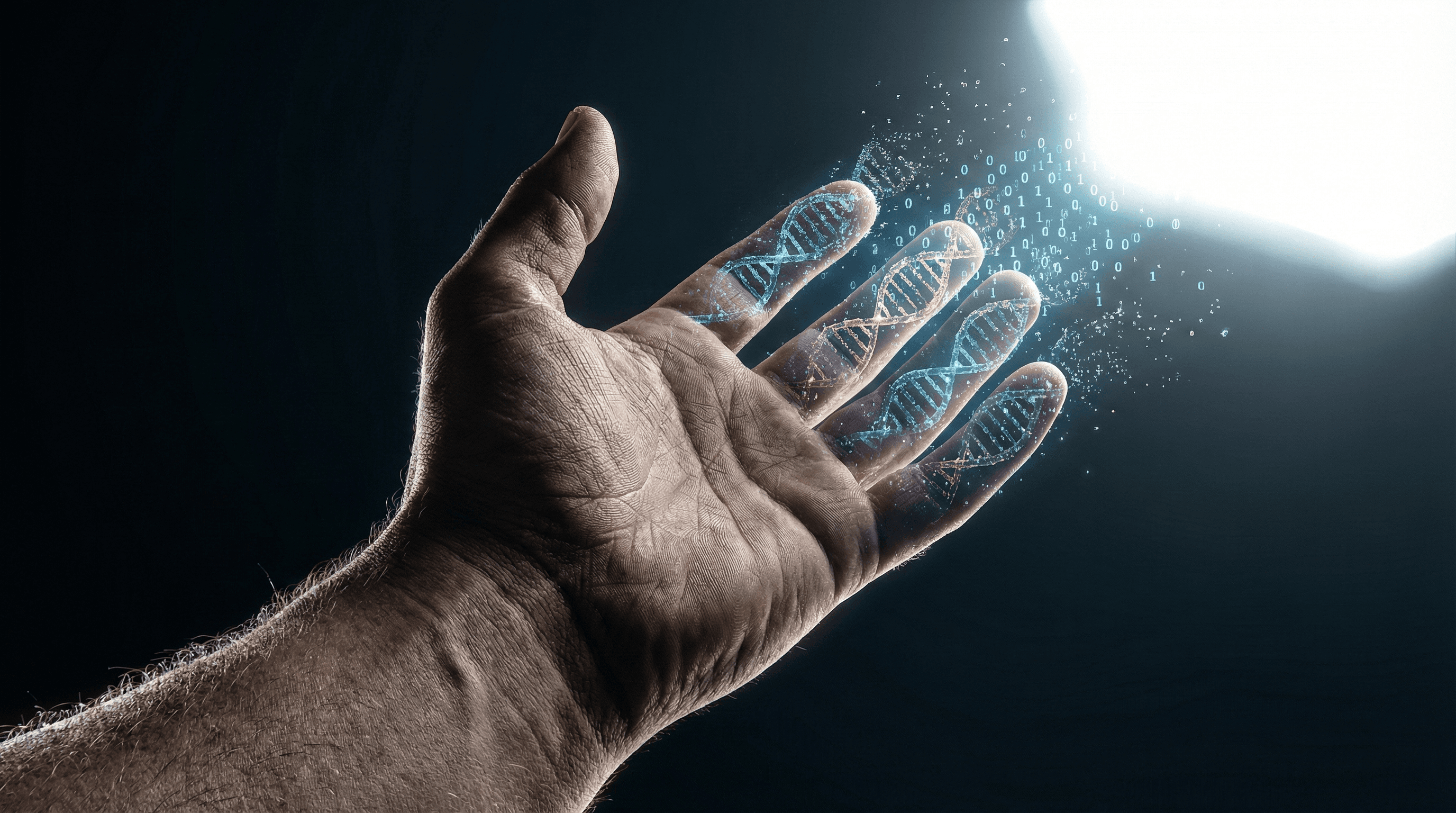
The Last Man: How the Biotechnological Singularity Abolishes Death and Rewrites Our Species
We are on the verge of an event unprecedented in the history of our planet - a moment when biological evolution, which has progressed at a snail's pace for billions of years, is overtaken by a technological explosion. Scientists call it the “biotechnological singularity.” It is the point at which we cease to be creatures and become creators. Powered by five gigantic engines – gene editing, artificial intelligence, regenerative medicine, synthetic biology and brain-computer interfaces – we are hurtling toward an era in which disease is an option and death is a technological problem that can be solved. But as we rewrite the code of life and fuse silicon with neurons, a coalition of Nobel laureates warn of a danger as exotic as it is deadly: "mirror life." This is not science fiction; it is the report from the laboratories that are already designing the year 2050. Are we ready to play gods or are we creating our own demise?

Your free account
Save interesting articles, track your reading progress and connect with other readers. Joining Pandragora is free.
Discover more with Premium
Start a subscription to get unlimited access to all articles.
The first of these engines is the molecular scalpel, which gives us the power not only to read but to edit the book of life. It began modestly in 1973 with the recombination of plasmids, but the real fire was only lit when researchers discovered a strange defense system in bacteria: CRISPR. Through the work of Jennifer Doudna and Emmanuelle Charpentier, what was once an obscure microbiological curiosity was transformed into the most precise tool in medical history - a pair of "genetic scissors" that can cut and rewrite DNA, for which they won the Nobel Prize. But science hasn't stopped. We are already well beyond the brute force of the original CRISPR-Cas9 system, which causes double-strand breaks in DNA. The new avant-garde is called “Base Editing” and “Prime Editing”. Imagine being able to correct a single typo in a massive novel without tearing out the page. Base Editors, introduced in 2016, chemically convert one DNA building block into another without dangerously cutting the helix. Prime Editors, which followed in 2019, act like a "search-and-replace" function in a word processor and allow genetic information to be rewritten directly.
The implications of this precision are breathtaking and already a reality. In 2023, the FDA approved the first CRISPR therapy for humans, a historic milestone. Patients with sickle cell anemia or beta thalassemia, who were previously dependent on lifelong, painful blood transfusions, are now cured by editing their own stem cells - they now live without foreign blood. But that's just the beginning. In a clinical trial in 2024, patients with a genetic form of blindness, Leber congenital amaurosis, regained their sight after being injected with a gene editor directly under the retina. We even attack cholesterol levels directly at the root: In primate studies, switching off the PCSK9 gene was able to permanently reduce “bad” LDL cholesterol, which represents a paradigm shift in the fight against cardiovascular diseases. Even viruses that burrow deep into our DNA are no longer safe. Genetic scissors are used against HIV, which is hiding in our genomes, to remove the CCR5 receptor - the virus's portal of entry. A clinical trial recently showed promising results for possible viral cleansing.
But biology is complex, and to master this complexity, humans need a partner who sees patterns where we only see chaos. This is where the second engine of the singularity comes into play: artificial intelligence. What began with Deep Blue's victory in chess has become an indispensable oracle of medicine. In 2006, Geoffrey Hinton laid the foundation for deep learning, neural networks that mimic the human brain. Today, these networks see more than any radiologist. Back in 2017, an AI model outperformed human experts in diagnosing skin cancer. But the real revolution takes place in secret, at the level of molecules. Deciphering the human genome once took over a decade; today we sequence an entire genome in five hours. This flood of data would be unmanageable for the human mind, but AIs like AI-MARRVEL comb through it to diagnose rare genetic diseases.
Perhaps the most dramatic triumph of AI, however, is AlphaFold. For decades, predicting the three-dimensional structure of proteins has been one of the toughest problems in biology. AlphaFold solved it and now provides insights that radically accelerate the development of drugs against Alzheimer's or heart disease. Where the development of a new drug once cost over a billion dollars and took 14 years, AI now designs molecules in fast motion. AI-designed drugs for pulmonary fibrosis are already in Phase II trials - evidence that we are moving from experience-based medicine to algorithmic precision science.
While we eliminate diseases, one enemy remains undefeated: time. This is where the third engine comes into play: regenerative medicine, a field that promises no less than reversing aging itself. Aging is not understood here as an inevitable fate, but rather as an accumulation of cellular damage and stem cell exhaustion. The discovery of induced pluripotent stem cells (iPSCs) by Shinya Yamanaka in 2006 gave us the key to turning back the cell clock. We don't just repair anymore; we reprint. Bioprinting, the layer-by-layer application of living cells, enables the creation of tissue in the laboratory. Scientists have already printed multi-layered skin constructs, complete with hair follicles and sweat glands, that heal without scarring. Imagine a world where organs are not donated but grown from your own cells - functional liver organoids already exist for drug testing.
The fight against aging is fought at the cellular level. Mesenchymal stem cells (MSCs) are used to regenerate the heart after a heart attack or to protect the brain from neurodegenerative diseases. In experiments, the blood of young mice - or more specifically, the exosomes in them - was able to rejuvenate the tissue of old animals. It is the modern, science-based fountain of youth. Clinical studies in humans already show that the administration of young stem cells can improve the physical function of older adults. We are moving toward a reality in which biological immortality moves from myth to technological feasibility.
But it is not enough for people to repair what is already there. With synthetic biology, the fourth engine, we begin to re-engineer life from scratch. It is the transition from reading and editing to writing entirely new biological stories. We build standardized biological components, so-called “BioBricks,” and assemble them into new organisms. The first synthetic bacterium with a chemically synthesized genome, “Synthia,” was just the beginning. Today we reprogram the body's own T cells so that they hunt cancer cells like living robots - CAR-T cell therapy, often referred to as the "third pillar of medicine". We are creating microbial factories that produce opioids or antibiotics that previously required us to harvest rare plants.
But lurking in this frenzy of creation is a shadow so dark that 38 leading scientists issued an urgent warning in December 2024. It's about "Mirror Life". Nature almost exclusively uses left-handed amino acids and right-handed DNA. Synthetic biology is on the verge of creating organisms with mirrored molecular chirality. Such “mirror bacteria” would be immune to all known viruses and predators because they do not “fit” molecularly. If they escape the laboratory, they could unstoppably dominate ecosystems and trigger irreversible ecological catastrophes. It is the ultimate biosecurity risk of a technology that has the potential to save the world or make it unrecognizable.
The final step towards the singularity is the merging of our mind with the machine: brain-computer interfaces (BCI). Since Philip Kennedy inserted an implant into the first patient in 1998 that allowed him to control a cursor using his thoughts, the field has developed explosively. Today we have moved far beyond simple cursor movements. Implanted electrodes allow paralyzed people to control robot arms and write texts using their thoughts. The latest generation of speech prostheses captures the neural signals directly from the cortex and translates them into synthetic speech in real time - with a delay of just 80 milliseconds. A patient who has lost his voice due to ALS can communicate fluently again, with a voice that is similar to his own. We are on the threshold of a symbiosis in which cognitive prostheses expand our memory and we share thoughts directly with AI systems.
These five technologies are not racing on parallel tracks; they collide and merge. AI designs the genes we edit with CRISPR to optimize stem cells that we print into synthetic tissues controlled by brain interfaces. The result is a world in which the boundaries between man and machine, between what is born and what is made, are completely blurred. A future is emerging in which we can eradicate disease and dramatically extend our lifespans. But it is also a future that raises fundamental questions. If immortality is for sale, will we see humanity split into a long-lived, genetically optimized elite and a "natural" underclass? In our pursuit of perfection, will we sacrifice the genetic and cultural diversity that makes us human?
We are entering an era in which we assume roles we have attributed to gods for millennia: creating life, transforming nature, and redefining mortality. The biotechnological singularity is no longer a distant utopia; it is the cumulative force of the breakthroughs we are seeing in the labs today. The question is no longer whether this transformation will come, but whether our wisdom can keep pace with our technological omnipotence. We are faced with a choice: Do we use these tools for an unprecedented flourishing of human health and prosperity, or do we lose the very thing that makes us human in the optimization of our biology?
Question: Wen, Z., Yang, Yang, Yang, Yang, Yang, J., Parviain, A., Chen, X, Li, Q., VanDeusen, Ma, Ma, & Tay, F. (2025). The path to biotechnological singularity: Current breakthroughs and outlook. Biotechnology Advances, 84, 108667. Doi: https://doi.org/10.1016/j.biotechadv.2025.108667
Share or save this article
Share this post or save it for later. A like helps make relevant content more visible.
We place great emphasis on accuracy in our research. Nevertheless, errors can occur. We also recommend reading the corresponding primary literature listed in the sources. The content on Pandragora is for general information only and does not replace professional medical advice or treatment. Use of the information provided is expressly at your own risk and responsibility; any liability is excluded.