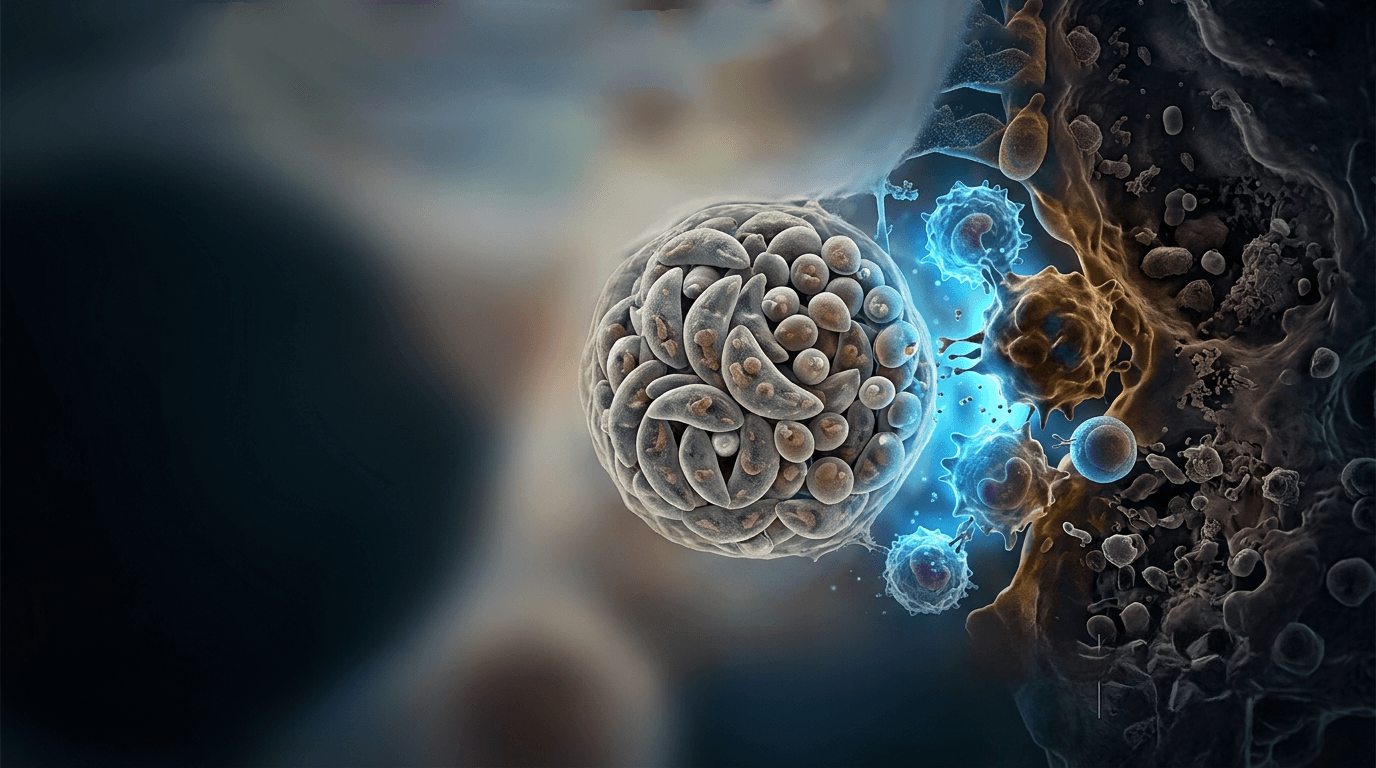
Toxoplasma gondii: The parasite that inhibits and promotes cancer
The parasite Toxoplasma gondii can both fight and promote cancer. Are you wondering how this can be? In this systematic review, researchers analyze dozens of experimental studies. You will find out why the stage of the infection is crucial and which molecules of the parasite are responsible for the respective…

Pandragora Listening Mode
Full articlePlay the complete audio version of this article.
At a glance
Toxoplasma gondii (T. gondii) is an intracellular parasite that influences tumor biology in complex and often contradictory ways, as shown in this systematic review. Acute infection or exposure to certain parasite antigens consistently leads to anti-tumor effects in experimental models. This happens by activating your innate and adaptive immune system, reversing immunosuppression in the tumor microenvironment, inducing apoptosis and inhibiting new vessel formation. In contrast, chronic infections or exposure to specific virulence factors such as the ROP18 effector protein or exosomal microRNA miR-21 can promote tumor growth. The effect of T gondii depends crucially on the stage of infection and the type of antigen exposure. For future cancer immunotherapies, consider developing attenuated, non-replicating T. gondii strains and selected recombinant antigens should be considered, with safety and efficacy being rigorously assessed.
Toxoplasma gondii and cancer: A systematic analysis of contradictory effects
The intracellular protozoan parasite Toxoplasma gondii (short: T. gondii), a globally distributed microorganism, is known to comprehensively modulate host immunity and cellular signaling pathways. This potential sparked scientific interest in its impact on cancer biology. The central research question addressed in this systematic review is how T. gondii influences cancer growth. The parasite has been shown to have a remarkable dichotomy: it can both inhibit and promote tumors.
This systematic review summarizes the experimental evidence on the anti-tumor and pro-tumor effects of T. gondii infection and its antigens derived from the parasite. A comprehensive PubMed search up to the 9th. The analysis was carried out in September 2024 and formed the basis for the analysis. A total of 54 experimental studies published between 1971 and 2024 were included in the analysis. It is important to note that all of these studies were preclinical in nature, i.e. they were carried out either in vitro (on cell cultures) or in vivo (on animal models), with 41 studies taking place exclusively in vivo, 10 exclusively in vitro and 3 both in vitro and in vivo. There are no human clinical studies examining these effects.
The results show a clear distribution of effects: 46 of the studies reported antitumor effects of T. gondii or its components. In contrast, only two studies showed pro-tumor effects. Another study identified divergent effects that depended on the stage of infection, with acute infections exhibiting anti-tumor effects and chronic infections exhibiting pro-tumor effects. Five studies focused on the analysis of signaling pathways responsible for cancer development after T. gondii infections are relevant.
Investigating the underlying mechanisms was a main aim of this systematic review. It became clear that the mode of action of T. gondii is complex and depends on various factors, including the stage of infection (acute vs. chronic) and the type of parasite exposure (e.g. by live wild-type strains, attenuated strains, parasate lysates or recombinant antigens). This distinction is crucial for understanding the potential application of T. gondii-based immunotherapies against cancer.
The antitumor effect: Like T. gondii mobilizes the immune system against cancer
The most frequently described antitumor effect of Toxoplasma gondii (T. gondii) in the experimental studies examined (28 of 54) is the activation of the innate and adaptive immune systems as well as the reversal of immunosuppression in the tumor microenvironment (TME). The tumor microenvironment (TME) is the complex environment around a tumor that includes not only cancer cells but also a variety of immune cells, blood vessels and other supporting cells that can influence tumor growth. An acute infection with T. gondii or exposure to certain parasite antigens triggers a strong pro-inflammatory T helper 1 (Th1) immune response.
This Th1 response is largely driven by the cytokines interleukin-12 (IL-12) and interferon-gamma (IFN-γ), which act as messengers of the immune system and are crucial for the coordination and amplification of immune reactions. Acute infection with sulfadiazine-treated T. For example, in mouse models, gondii led to the activation of macrophages and microglia, causing non-phagocytic cytotoxicity (ability to directly kill cells without engulfing them) and delaying and reducing tumor growth.
In NK cell-deficient mice, acute T. gondii infection restored the cytotoxic activity of natural killer cells (NK cells) via IFN-dependent signaling pathways, demonstrating potent innate immune activation.
Numerous preparations containing only parasite antigens, such as formalin-fixed tachyzoites and tachyzoite lysate antigens (TLA), stimulated macrophage phagocytosis (uptake and digestion of foreign substances or cells), increased the cytotoxic activity of leukocytes (white blood cells), and suppressed the growth of lymphomas, sarcomas, and Lewis lung carcinomas. Injection of TLA into dendritic cells (DC), specialized immune cells that present antigens and initiate immune responses, resulted in increased IL-12 production and activation of CD8±T cells, a type of cytotoxic T cells that can directly kill infected or cancer cells.
Attenuated, non-replicating T. gondii strains, including mutant strains such as ACPS, Aldh, Aompdc, Agra5, Agra17 and uracil auxotrophic strains (NRUA), also showed promising effects. They robustly reversed tumor-associated immunosuppression, reactivated “anergic” CD8±T cells (T cells that are inactivated or exhausted and no longer respond effectively to antigens), and induced durable tumor regression in ovarian, melanoma, and pancreatic tumors. These strains increased Th1 immunity, CD4± and CD8± T cell infiltration in the TME, and reduced myeloid-derived suppressor cells (MDSCs), a type of immune cell that can suppress the immune system and promote tumor growth.
Additionally, purified Toxoplasma protein fractions promoted the pro-inflammatory Th1 immune response and slowed melanoma growth. Macrophages expressing GRA15II (a recombinant protein from T. gondii), were polarized into an antitumor M1 macrophage phenotype. M1 macrophages are a type of macrophage that play a pro-inflammatory role and can help fight tumors and infections. These M1 macrophages inhibited hepatocellular carcinoma by releasing pro-inflammatory cytokines such as TNF-α and IL-12 and reducing pro-tumor factors such as IL-10, IL-6, TGF-β and VEGF.
Another mechanism was observed through DC-derived exosomes (small vesicles released from dendritic cells that transport proteins, lipids and nucleic acids) from ME49 strain-infected DCs. These exosomes induced STAT1-dependent M1 macrophage polarization via the microRNA miR-155-5p. MicroRNAs are small, non-coding RNA molecules that regulate gene expression. miR-155-5p is a specific microRNA that here contributed to the polarization of macrophages. All of these immune-mediated changes result in a reprogramming of the tumor microenvironment away from immunosuppression toward an environment that enables efficient immune recognition and elimination of malignant cells.
This transformation of immunologically “cold” tumors, which contain few immune cells, into “hot” tumors, which are heavily infiltrated by immune cells and respond well to checkpoint blockade, is considered a key mechanism for the effectiveness of immunotherapies.
Direct attacks on the tumor: apoptosis, inhibited growth and molecular deception
In addition to activating the immune system, experimental studies show that Toxoplasma gondii and its components can also exert direct anti-cancer effects on tumor cells. These cell-intrinsic effects were described in 18 of the studies analyzed and include apoptosis induction, inhibition of angiogenesis, molecular mimicry and modulation of intracellular signaling pathways.
Apoptosis induction: Three studies (6% of total studies) demonstrated that T. gondii can trigger programmed cell death, so-called apoptosis, directly in tumor cells, independent of immune mechanisms. Apoptosis is a controlled process of cell death necessary to eliminate damaged or unwanted cells and maintain balance in tissues. So could a T. gondii lysate antigen (TLA) which induce apoptosis in human glioma cells and effectively block their growth [39]. An acute infection with a wild RH strain of T. gondii led to rapid apoptosis in HER2/Neu±breast cancer cells [40].
An attenuated ME49 strain activated intrinsic apoptotic signaling pathways by significantly increasing pro-apoptotic proteins Bax and Bak as well as cytochrome c regulators. This was accompanied by a significant increase in caspase-3 activity, an enzyme that plays a key role in the execution of apoptosis, and led to a reduction in tumor burden in Ehrlich ascites carcinoma [41]. These findings suggest that T. gondii or its antigens can initiate caspase-dependent mitochondrial apoptosis in tumor cells.
Anti-angiogenesis: Five studies (9%) showed a reduction in tumor vascularization after exposure to T. gondii. Angiogenesis is the formation of new blood vessels that tumors need for their supply and growth. Acute RH strain infection reduced tumor vascularization in melanoma and lung carcinoma models by eliminating the expression of vascular endothelial growth factor (VEGF), a crucial signaling molecule for angiogenesis, and reducing microvessel formation [42]. Acute infection also inhibited angiogenesis in Lewis lung carcinoma, complementing a triggered Th1 immune response [43].
TLA reduced the expression of CD31, a marker associated with angiogenesis, and increased interleukin-12 (IL-12) levels, a cytokine that suppresses tumor vascularization [44,45]. An autoclaved Toxoplasma vaccine (ATV) reduced VEGF in Ehrlich carcinoma [46]. These anti-angiogenic effects are a reproducible, cytokine-coupled mechanism of tumor suppression.
Molecular mimicry: Two studies (4%) identified antigenic cross-reactivity and the presence of shared epitopes between T. gondii antigens and cancer cells. Molecular mimicry describes the phenomenon in which pathogen molecules are so similar to those of the host that they trigger a similar immune response. Serum from T gondii-infected mice bound selectively to tumor cells but not to normal lymphocytes, suggesting specific antigen recognition by infection-induced antibodies [47]. ATV showed common protein bands with Ehrlich carcinoma, suggesting molecular mimicry and cross-reactive immune recognition [48]. These findings support molecular mimicry as a mechanism for parasite-induced tumor control.
Cell-intrinsic signaling pathways: Eight studies (15%) demonstrated direct modulation of tumor-intrinsic signaling pathways by T. gondii or its effector proteins. Cell-intrinsic signaling pathways are complex networks within cells that control their functions, growth and survival. Acute RH strain infection suppressed the growth of hepatocellular carcinoma by altering cell cycle regulators and reducing cell proliferation (G0/G1 cell cycle arrest through downregulation of cyclin B1 and cdc2). Additionally, it promoted pro-apoptotic signaling pathways through an increase in caspase-3 and a decrease in the anti-apoptotic protein Bcl-2 [49].
Acute ME49 strain infection induced apoptosis in human T-cell leukemia cells via the NF-κB signaling pathway (an important transcription factor involved in inflammatory responses and cell growth) and related regulatory proteins through upregulation of the A20 protease (which inhibits NF-κB activation) and downregulation of the anti-apoptotic protein ABIN [50].
Recombinant parasite proteins also played an important role. Recombinant ROP16 protein (rROP16) induced apoptosis in neuroblastoma cells through activation of the p53 signaling pathway, an important tumor suppressor function. This occurred through direct serine 15/37 phosphorylation of p53, increased expression of the pro-apoptotic Bax protein and caspase 9, and resulted in G1 phase cell cycle arrest through increased p21 expression (a known cell cycle inhibitor) and decreased CDK expression [5]. rROP16 also inhibited the proliferation of lung adenocarcinoma cells by activating STAT3, inducing G1 cell cycle arrest, and reducing cancer cell invasion and migration through regulating p53, Bax, Bcl-2, cleaved caspase 3 and caspase 9 [52].
A recombinant GRA8-derived peptide activated mitochondria (“metabolic resuscitation”) in colon cancer cells, leading to apoptosis [51]. The recombinant GRA16 protein (rGRA16) stabilized the tumor suppressor protein PTEN and activated p53 tumor suppression pathways in various tumors [6]. Furthermore, rGRA16 inhibited AKT/NF-κB signaling pathways and induced G2/M cell cycle arrest and apoptosis in non-small cell lung carcinoma cells, thereby reducing chemoresistance [7]. These results demonstrate that acute infections and parasite effector proteins can also activate cell-intrinsic tumor suppressor networks independently of immune activation.
The dark side: How chronic infections and certain parasite proteins promote cancer
While Toxoplasma gondii and its antigens can exhibit diverse antitumor effects, research has also uncovered a “dark side”: Under certain conditions, chronic infections and specific parasite proteins can promote cancer growth. Two studies (4% of studies analyzed) identified infection-induced signaling pathways that may promote tumor survival.
A crucial factor that was able to trigger cancer-promoting effects in the laboratory is the effector protein ROP18 (Rhoptry Protein 18). In glioblastoma cells it was shown that the expression of ROP18 after T. gondii infection inhibited mitochondrial apoptosis by blocking P2X1 signaling. Mitochondrial apoptosis is a natural mechanism of programmed cell death designed to eliminate cancer cells. By inhibiting this process, ROP18 promoted tumor cell survival. This is in contrast to the antitumor effects observed with other parasite proteins such as ROP16.
Another pro-tumor mechanism was mediated by exosomal microRNA (miR-21) produced by T. gondii-infected microglial cells. Exosomes are small vesicles secreted by cells that transport messenger molecules such as microRNAs between cells. In the laboratory, it was shown that this infectiously derived miR-21 downregulated tumor suppressor genes such as FoxO1, PTEN and PDCD4. These genes are normally responsible for inhibiting cell growth. In the experiment, their suppression led to accelerated glioma growth.
The dichotomy of T. gondii effect is particularly evident when infection status is taken into account. A 2024 study directly compared the effects of acute versus chronic infection in animal models. While acute infection with an RH strain inhibited tumor growth by enhancing the Th1 immune response and increasing cytotoxic CD8+ cells in the tumor microenvironment (TME), chronic infection with an ME49 strain enhanced immunosuppression in the TME. This occurred through a decrease in cytotoxic CD8+ cells and Th1 cell infiltration, which facilitated tumor progression. These results underline that the time of infection and the prevailing cytokine environment largely determine the influence on the tumor.
These findings are an important reminder: they highlight that the pro-tumor potential observed in chronic infections and certain virulence factors such as ROP18 warrant precise antigen selection and rigorous safety assessment for future T. gondii-based cancer therapies are required. Therefore, precise selection of parasite strains and antigens as well as strict control of the course of the infection are crucial.
Outlook: Kann T. gondii be a blueprint for future cancer therapies?
Evidence from five decades of experimental research shows that Toxoplasma gondii's interaction with cancer biology is a mixed blessing. The analysis shows that acute infections - including those with non-replicating, attenuated T. gondii strains – and exposure to certain parasite antigens were able to trigger predominantly anti-cancer effects in the laboratory. These include the rhoptry protein ROP16, the dense granule proteins GRA5, GRA6Nt, GRA8-derived peptides, GRA15II, GRA16, GRA17 and DC-derived exosomal microRNA miR-155-5p. Their effects included activation of innate and adaptive immunity, reversal of immunosuppression in the tumor microenvironment, induction of apoptosis, inhibition of angiogenesis, molecular mimicry and modulation of cell-intrinsic signaling pathways.
On the other hand, there was also evidence of cancer-promoting effects. These have been observed in the laboratory, particularly during chronic infection and when exposed to specific virulence factors such as the effector protein ROP18 and the microRNA miR-21. ROP18 inhibited mitochondrial apoptosis in tumor cells, while exosomal miR-21 suppressed the expression of tumor suppressor genes. These results highlight that the pro-tumor potential in chronic infections or in the expression of certain parasite factors requires precise antigen selection and rigorous safety assessment for any future T. gondii-based cancer therapy is essential.
However, the studies analyzed have important limitations. The data comes exclusively from in vitro cell culture models and in vivo animal models; there are no human studies. In addition, the heterogeneity of the studies examined is considerable, as very different parasite strains, infection routes, tumor models and antigen preparations were used. This made direct comparison difficult and a quantitative meta-analysis of the anti-tumor and pro-tumor effects impossible. Detailed mechanistic interpretation was also limited in some cases by incomplete molecular analysis of the underlying signaling pathways.
The literature search was also conducted primarily in a single database (PubMed), which leaves open the possibility that relevant studies from other sources were overlooked.
For future translational research and possible therapeutic applications, researchers should focus not on live parasites but on safer alternatives. These include in particular weakened, non-replicating T. gondii strains as well as selected recombinant parasite proteins that have demonstrated antitumor activity. These non-replicating strains and recombinant proteins were able to robustly induce pro-inflammatory Th1 immune responses (IL-12/IFN-γ) without posing the risks of uncontrolled parasite replication. They are conceptually similar to microbial immunotherapies such as Bacillus Calmette-Guérin (BCG) in cancer treatment.
A promising possibility could also be the development of mRNA vaccine platforms that specifically target selected T. express gondii antigens with high immunogenic and antitumor potential. Such approaches are particularly promising for immunologically “cold” tumors, such as glioblastomas. However, prior to any clinical use, a rigorous evaluation of the safety and efficacy of these non-replicating T. gondii strains and recombinant proteins are required. In addition, epidemiological studies should further investigate the higher Toxoplasma IgG seroprevalence in cancer patients in order to clarify whether the Toxoplasma infection status influences the course of the disease (e.g. B. progression-free survival).
Note on sources
Individual statements were not adopted because they could not be clearly verified based on the available source.
Those
Originaldokument: Toxoplasma gondii Anti Tumor.pdf
Share or save this article
Share this post or save it for later. A like helps make relevant content more visible.
We place great emphasis on accuracy in our research. Nevertheless, errors can occur. We also recommend reading the corresponding primary literature listed in the sources. The content on Pandragora is for general information only and does not replace professional medical advice or treatment. Use of the information provided is expressly at your own risk and responsibility; any liability is excluded.
Disclaimer: Dieser Artikel wurde von unserem KI-Agenten generiert. Der Agent ist so eingestellt, dass er möglichst gewissenhaft arbeitet. Fehler können allerdings immer passieren. Wir empfehlen also für eine punktgenaue Information auch die Originalliteratur zu konsultieren.