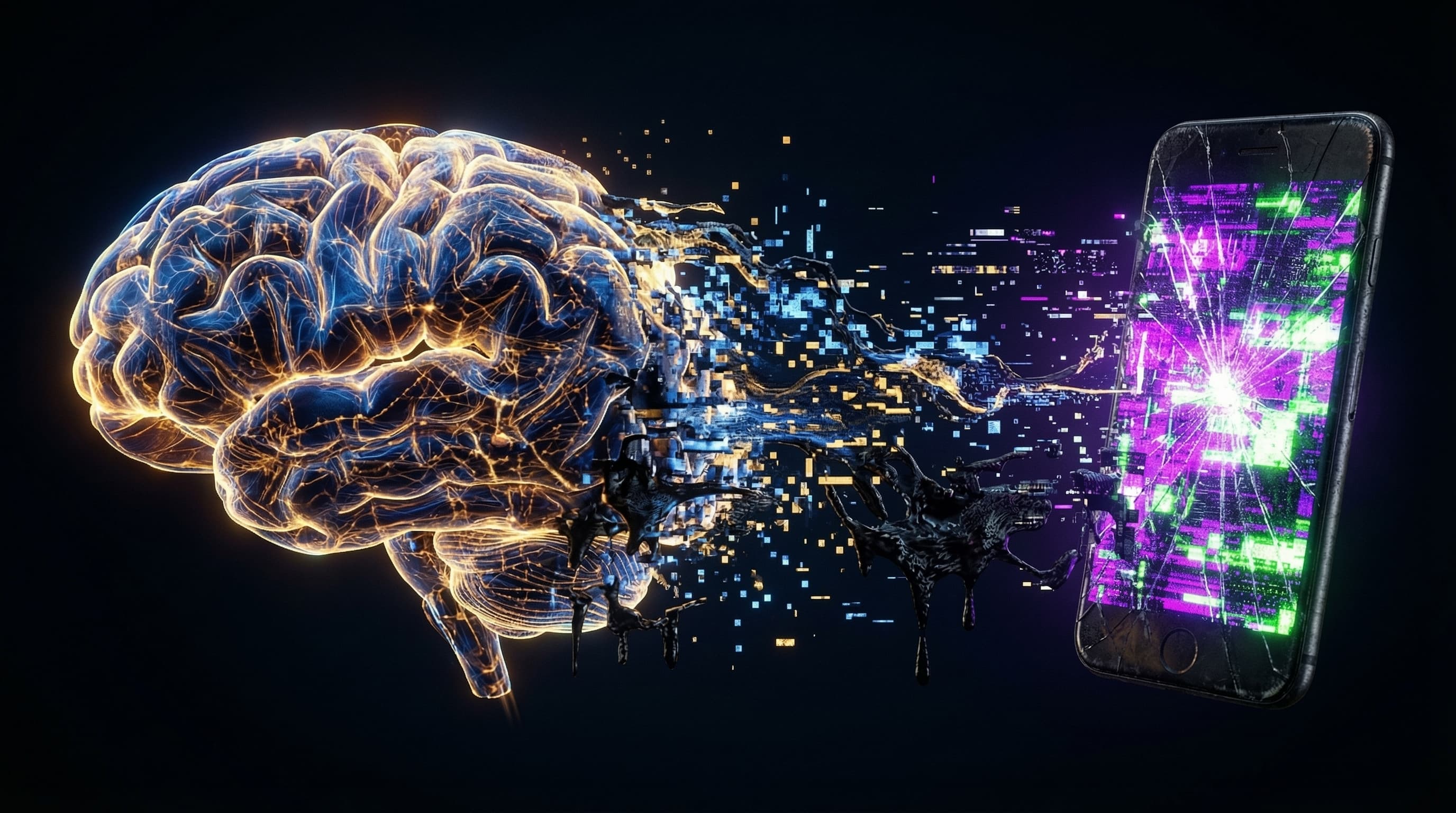
ARE WE GETTING STUPIER?
Some scientific studies provide evidence that we may be getting dumber. But why is this the case and what can we do about it?

Your free account
Save interesting articles, track your reading progress and connect with other readers. Joining Pandragora is free.
Discover more with Premium
Start a subscription to get unlimited access to all articles.
The beginning of the end of wisdom
“Humanity will not perish with a bang, but with a gentle swipe of the touchscreen.”
— Based on T. S. Eliot
There are messages that you would prefer to ignore. For example, that humanity is, statistically speaking, becoming dumber. Not suddenly, not apocalyptically, but slowly, steadily and with the same consequence that you gain weight when you order pizza every night. Quiet, measured in decimals per decade. But measurable.
The original Flynn effect, named after researcher James R. Flynn, described a pleasing observation: Over the entire 20th century. Throughout the 20th century, IQ test scores rose steadily in most countries around the world — by about three IQ points per decade. Each new generation was, at least on paper, a little smarter than the last. Better nutrition, better education, a more complex environment — civilization seemed to keep its promise (Flynn, 2012).
Then the turning point came. Since the late 1990s, researchers in many highly developed countries have observed a stagnation or even a reversal of this trend. The Flynn effect, that beautiful rising curve, started to tip over. This is called the “negative Flynn effect,” and it sounds about as reassuring as it reads.
Arguably the most robust study on the subject analyzed the IQ test results of over 730,000 Norwegian conscripts born between 1970 and 2009. The result was sobering: For those born around 1975, IQ reached its peak. After that, things went downhill — by about 0.2 IQ points per year, which adds up to almost seven points per generation (Bratsberg & Shiu, 2018). Seven points. That's the difference between "I get the joke" and "What joke?"
What's particularly alarming is that the decline could even be detected within families. On average, younger brothers performed worse than their older brothers. Same parents, same home, same food — and still a lower IQ. This largely rules out purely genetic explanations and points to environmental factors. Something in our world makes us measurably less efficient.
This trend is not a Norwegian curiosity. Systematic reviews confirmed the negative Flynn effect in Denmark, Great Britain, Finland, the Netherlands, France and Germany (Dutton et al., 2016). The decline primarily affects so-called “fluid intelligence” — the ability to reason and recognize patterns. These are exactly the skills that once catapulted us as a species to the top of the food chain.
Of course there are counterarguments. Maybe IQ tests just measure the wrong thing. Maybe we're not dumber, but smarter in a different way — better multitaskers, more adept at filtering information, more skilled at touchscreen wipers (Flynn, 2012). That's a comforting thought. Unfortunately, as we will see in the following chapters, it is a false one.
CHAPTER 2
When our brains were bigger
“Evolution has no humor. It just takes things away from you that you no longer use.”
— Anonymous
Before we turn our attention to the digital age and its destruction, it is worth taking a look at the past. Because the history of the human brain is, with all due respect, a story of decline — at least as far as volume is concerned.
It is a scientifically well-documented fact that the average brain size of Homo sapiens has decreased over the last millennia. The largest brains in the human evolutionary lineage are not found among us, the proud inhabitants of the 21st century. Century, but with our ancestors in the late Pleistocene — 10,000 to 30,000 years ago. The average brain volume of modern humans is about 10 to 15 percent smaller than that of Cro-Magnon humans. This reduction occurred mainly in the last 20,000 years, with particular emphasis in the last 3,000 to 6,000 years (DeSilva et al., 2021).
Now one could object: bigger doesn't mean better. And that’s true — up to a point. A modern smartphone fits in your pocket and is more powerful than a 1970s mainframe computer that filled an entire room. Similarly, a smaller brain could be just as powerful through optimized “software” — better wiring, higher synapse density, more efficient signal transmission. After all, our brain already uses around 20 percent of our total body energy. A shrinkage treatment would therefore make perfect economic sense.
But why has it shrunk? The most convincing theory comes from DeSilva and colleagues (2021), who drew a fascinating parallel to the animal world: ants. In ant species that live in highly organized colonies with a strict division of labor, the individual brain also shrinks. The individual ant has to know less because the colony “thinks” as a whole. This is called distributed cognition or the “collective brain.”
Maybe something similar will happen to us. As people began to live in larger groups, pass on knowledge through language and writing, and specialize in professions, each individual no longer had to know everything. The hunter no longer had to be a healer, the farmer no longer had to be a navigator. We have “outsourced” our knowledge to society. The brain could become more energy efficient — because who needs a general-purpose survival computer when you can just ask your neighbor?
Parallel to this is the self-domestication hypothesis. Domesticated animals — dogs compared to wolves, domestic pigs compared to wild boars — consistently have smaller brains than their wild ancestors. The reason: When breeding for social compatibility and lower aggressiveness, brain size is also reduced (Cieri et al., 2014). According to the theory, humans have “tamed” themselves over the course of thousands of years. A smaller brain was the “price” for peaceful coexistence. What a trade.
CHAPTER 3
The Swiss army knife and the scalpel
“Put a modern human naked in the forest and he’ll try to guess the trees’ Wi-Fi password.”
- Unknown
Imagine waking up naked in a wilderness tomorrow morning. No smartphone, no supermarket, no Google Maps. The honest question is: How long would you survive?
A hunter-gatherer from the Stone Age would not have even smiled at this question. For him, the “wilderness” wasn’t an adventure vacation, but everyday life — and he was a master at it. Each individual had to be an expert in a variety of disciplines: intuitive physics and engineering for tool making (studies show that the same areas of the brain are active as for complex planning and language; Stout & Chaminade, 2012), botany and zoology for identifying hundreds of plant and animal species, navigating thousands of square kilometers without any aid, and social intelligence in a world where the wrong word at the wrong moment could mean a death sentence.
Any mistake was potentially fatal. Eating the wrong berry? To. Misinterpreting the animal track? To. Misjudge the weather? To.
You could compare the Stone Age man's brain to a Swiss Army knife: it had a variety of tools that were good enough for almost any situation imaginable. It was a general purpose survival computer. Modern humans' brains are more like a scalpel: incredibly sharp and precise for a very specific task, but completely unsuitable for felling a tree or skinning an animal.
We have become extremely good at manipulating abstract symbols — reading, writing, programming, spreadsheets. Skills that would have been as useful to a hunter-gatherer as an umbrella is to a fish. Researcher Joseph Henrich put it this way: Homo sapiens' real evolutionary advantage is not superior individual intelligence, but our ability for cumulative cultural learning. A single person could never invent a smartphone alone, but humanity as a collective can (Henrich, 2016).
This is simultaneously our greatest strength and our greatest weakness. Because what happens if the collective fails? When the power is gone, the internet is silent and the supermarket remains empty? Then there is a highly specialized marketing manager with excellent Excel skills — and no idea which of the berries on the side of the road will kill him and which will feed him.
CHAPTER 4
Digital dementia: When the smartphone takes over thinking
“We have supercomputers in our pockets and use them to watch cat videos.”
— The tragedy of our time
The term “digital dementia” is not a clinical diagnosis. Rather, he describes a gradual collection of cognitive deficits that accompany the excessive use of digital media. You could also say: It's what happens when you retire your brain and let Google do the work.
The first mechanism is called cognitive offloading — affectionately known as the “Google effect.” In a legendary study, Sparrow and colleagues (2011) showed that subjects remembered facts significantly more poorly if they believed the information was stored on a computer. The brain learns at an impressive rate that it can save itself from storing as long as an external source is available. Why remember something when you can look it up at any time? Unfortunately, our comfortable brain is of very little interest in the answer - because this means that robust, long-term knowledge structures do not even emerge in our heads.
The second mechanism is changing our reading habits. We have moved from linear, deep reading of entire books to quickly scanning and skimming online texts. Neuroscientist Maryanne Wolf warns that this change affects the ability for complex thinking and abstraction (Wolf, 2018). We don’t read anymore — we skim. And skimmed knowledge is like skimmed food: it doesn't nourish.
And then there is the atrophy of specific abilities. The constant use of GPS navigation causes our spatial orientation to become crippled. Studies show that the hippocampus — the central brain structure for spatial memory — is less active in GPS addicts and may lose volume in the long term (Firth et al., 2019). We don't navigate anymore. We follow a blue line on the screen like a dog on a leash.
CHAPTER 5
The multitasking paradox: The more you juggle, the more you drop
“Multitasking is the art of doing several things poorly at the same time.”
- Unknown
There's a common misconception about as persistent as the belief in unicorns: that people who constantly multitask become good at it. Science says: the opposite is the case.
The groundbreaking study by Ophir, Nass, and Wagner (2009) at Stanford University was intended to prove that heavy media multitaskers — people who regularly switch between televisions, laptops, and smartphones — are better at filtering information and switching tasks. The result was an academic shock.
The long-term jugglers were worse in all tested areas. They couldn't block out irrelevant information, their working memory was chaotically organized, and — to top it off — they were even slower and more error-prone when switching between two simple tasks. Those who multitask the most were the worst at it. The brain was not trained, but rather chronically distracted. The phenomenon has been given an appropriate name: the multitasking paradox.
The structural findings are even more disturbing. Loh and Kanai (2014) measured the brains of 75 healthy adults and discovered a significant negative correlation: the more a person multitasked, the less dense the gray matter was in their anterior cingulate cortex (ACC) — a region responsible for attention control, error detection, and cognitive control. The “control center” of the brain was literally thinner in those who juggled a lot.
Moisala and colleagues (2016) confirmed this with fMRI scans: even during simple tasks, the brains of heavy multitaskers showed inefficient, widespread activation. To achieve the same performance, it had to work harder and in a more uncoordinated manner - like an engine that is already running in the red zone at the lowest speed.
CHAPTER 6
The night belongs to the smartphone
“You can sleep when you’re dead. But without sleep you’ll die quicker.”
— Medical truism
What do many of us do late at night when we lie in bed? That's right: They pick up their smartphone and watch TikTok or something else. Then write a few important messages to a few friends on WhatsApp and Instagram, at the same time look at photos that don't actually interest you at all, but which you look at anyway, and maybe play a few games that you don't even enjoy, but at least kill the boredom.
The causal chain is as simple as it is brutal: using a smartphone in the evening leads to sleep deprivation, and sleep deprivation leads to reduced brain performance. The first mechanism is biological and is called melatonin suppression by blue light. In a tightly controlled laboratory study, Chang and colleagues (2015) showed that subjects who read from a screen in the evening had significantly suppressed melatonin levels — the “sleep hormone” kicked in about 1.5 hours later. The blue light tricks the brain into thinking it is still day. So you're lying in bed, but your brain thinks it's 3 p.m.
The second mechanism is psychological: Social media creates a state of cognitive and emotional arousal that is about as compatible with falling asleep as espresso is with valerian. Woods and Scott (2016) showed that high emotional investment in social media is associated with poorer sleep quality, lower self-esteem, and higher rates of anxiety. FOMO — Fear Of Missing Out — keeps the brain in a state of constant alertness.
The consequences are devastating. Sleep is not a passive period of rest — it is the maintenance layer of the brain. During deep sleep, the day's memories are transferred from the hippocampus to the neocortex. Walker and van der Helm (2009) summarized that just one bad night's sleep can reduce the ability to learn new facts by up to 40 percent. Forty percent. After one night.
Killgore (2010) showed the far-reaching effects: slowed reaction times, increased distractibility, reduced creativity. And as if that weren't enough, Yoo and colleagues (2007) discovered using fMRI that in sleep-deprived individuals, the amygdala — the emotional center of the brain — was over 60 percent more responsive, while rational control by the prefrontal cortex was virtually switched off. Poor sleep not only makes us dumber, but also more emotional, impulsive and irritable. No wonder the world is so on edge.
However, while we sleep, a lot more happens in our brain. During the day, a lot of molecular junk accumulates in our brain. Waste products created by metabolism and increased brain activity. This garbage must be removed. And that happens at night. The prerequisite: enough sleep. Without enough sleep, the garbage disposal only works to a limited extent. And this garbage leaves its mark. These traces impair our ability to think. If you don't sleep enough, you literally have more garbage in your head.
CHAPTER 7
Underwhelmed and overwhelmed at the same time
And this is where things get really absurd. Because the modern brain is not just under-challenged or just overwhelmed - it is both. At the same time. A paradox that drives cognitive decline from two sides at once.
On the one hand: cognitive underload. The brain no longer receives the kind of deep, complex training for which it was evolutionarily designed. Andel and colleagues (2016) showed in a large longitudinal study that people in jobs with low cognitive complexity — high routine, low problem solving — had a significantly higher risk of later developing dementia. Use it or lose it, says neuroscience. This also applies to your brain. And many of us don't use it anymore.
On the other hand: cognitive overload caused by stress. The prefrontal cortex, our “CEO of thinking,” is essentially shut down by chronic stress. Arnsten (2009) explained the mechanism: Stress hormones such as cortisol and norepinephrine disrupt the synaptic connections in the PFC. The brain switches from slow, reflective mode to fast, reactive survival mode. You can't think creatively if your brain thinks it's being chased by a tiger — even if the tiger is just an overdue email.
And then there is decision fatigue. In a famous field study, Danziger and colleagues (2011) analyzed over 1,100 sentences from probation judges. The probability of a positive decision was around 65 percent at the beginning of the day - and fell to almost zero as the day went on. The judges made worse decisions not because they were unfair, but because their brains were exhausted. And that's exactly what happens to us when we answer emails, make small decisions, and fill out forms all day long: cognitive resources are depleted by this superficial but tiring work. We are “busy” but neither productive nor challenged.
The result is a brain that is simultaneously out of practice and chronically fatigued. That's not a good combination. That's like tying a marathon runner to a sofa for a year and then forcing him to run the marathon in 35 degrees Celsius.
CHAPTER 8
The Perfect Storm: Toward Alzheimer's
And this is where things get serious. Because the effects described so far - digital dementia, sleep deprivation, chronic stress, cognitive underload - are not just annoying everyday phenomena. They are, and this is the really worrying finding of recent years, essential modifiable risk factors for the development of neurodegenerative diseases such as Alzheimer's.
The landmark Lancet Commission (Livingston et al., 2020) identified twelve modifiable risk factors that together account for approximately 40 percent of all dementia cases. Low education, lack of cognitive stimulation, sleep disorders and chronic stress are among them. These are exactly the factors that we described in the previous chapters.
The connection between sleep and Alzheimer's is particularly alarming. During deep sleep, the brain activates a waste elimination system called the glymphatic system. We touched on it briefly before: the garbage disposal in your brain. It flushes toxic metabolic products from the brain - especially amyloid-beta, the very protein that clumps together to form the infamous plaques in Alzheimer's disease. Xie and colleagues (2013) showed that this system is 60 percent more active during sleep. And Shokri-Kojori and colleagues (2018) used PET scans on humans to prove that even a single night of sleep deprivation leads to a significant increase in amyloid beta deposits.
Please take a few seconds and try to understand it in depth: every night you deprive yourself of sleep, you are preventing the garbage disposal in your brain from doing its job. And that means that with every single sleepless night you increase your risk of Alzheimer's or other neurodegenerative diseases.
Added to that is the stress. Chronically elevated cortisol levels are toxic to neurons in the hippocampus and promote inflammatory processes in the brain—neuroinflammation—now recognized as a core feature of Alzheimer's disease (Justice, 2018). The Everyday stress that you feel day after day is not harmless. It creates a biochemical environment that actively promotes neurodegeneration.
In summary: We build less cognitive protection, actively promote the deposition of Alzheimer's proteins and create an inflammatory environment in our brain. That’s not a risk — it’s a business plan for dementia.
CHAPTER 9
The rescue: what we can do about it
Fortunately, the brain is remarkably plastic and adaptable. The negative trends are not irreversible fates, but can be actively combated through targeted measures. The research provides four pillars of cognitive rescue.
Pillar 1: Active cognitive stimulation.
The most important finding: It's not just simple brain training that helps, but rather learning complex new skills. Learning a musical instrument is the gold standard — it trains the auditory system, fine motor skills, memory and executive functions all at the same time. Hanna-Pladdy and MacKay (2011) showed that older adults with more than ten years of music experience performed significantly better on memory and cognition tests.
Just as effective: learning a new language. Bak and colleagues (2014) showed that bilingualism can delay the onset of dementia by an average of 4.5 years — even if the second language was not learned until adulthood. Complex strategy games such as chess show similar effects (Borrell et al., 2017), as does deep, dedicated reading (Wilson et al., 2013).
The groundbreaking Finnish FINGER study (Ngandu et al., 2015) proved that a multidimensional approach—healthy diet, exercise, cognitive training, and management of risk factors—can significantly slow cognitive decline.
Pillar 2: Protect sleep.
Turn off all screens at least 60 to 90 minutes before bed. The smartphone doesn't belong in the bedroom — it belongs in a drawer in another room. Go to bed and get up at the same time every day, even on weekends. Gottlieb and colleagues (2019) confirmed in a large meta-analysis that good sleep quality is consistently associated with a lower risk of cognitive decline.
Pillar 3: Stress management.
Mindfulness meditation has proven to be particularly effective. Hölzel and colleagues (2011) showed that just eight weeks of mindfulness training increased gray matter density in the hippocampus — and reduced density in the amygdala, the “fear center.” Mindfulness is not esoteric mumbo jumbo, but targeted brain training that physically rebuilds the structure of the brain.
Pillar 4: Physical activity.
The “master lever” for brain health. Exercise boosts the production of the protein BDNF (Brain-Derived Neurotrophic Factor) — often referred to as the “miracle fertilizer for the brain.” Erickson and colleagues (2011) showed in a randomized controlled trial that brisk walking three times a week increased the size of the hippocampus by 2 percent — reversing one to two years of age-related decline. Simply. Stroll. Go.
CHAPTER 10
Get out of the dopamine trap
“You are not fighting against a lack of willpower. You’re fighting against a billion-dollar design budget.”
— Tristan Harris
Why is it so damn hard to put down your smartphone? Because smartphones and social media are purposefully designed to hijack our brain chemistry. The key mechanism is called intermittent variable reward — a principle that comes straight from addiction research. We never know when the next reward will come (a like, a message, an interesting post), and it is this unpredictability that creates maximum dopamine release. It is the same mechanism that makes slot machines addictive (Alter, 2017). Except that the slot machine is in our pocket and is open 24 hours a day.
The most effective counter-strategy is environmental design. Activate grayscale mode — because colors, especially the red of notifications, are strong emotional triggers. Radically turn off all notifications — one study showed that it can take up to 23 minutes to get back to a task after an interruption (Mark et al., 2008). Make the home screen boring: Hide addictive apps and only leave “tools” visible.
Then break the habit loop, as Charles Duhigg (2012) describes it: Identify triggers (boredom? Stress?), understand the desired reward (distraction? Connection?) and start a new routine. Instead of picking up your cell phone: pick up a book, take three deep breaths, go for a walk. Sounds simple, but requires practice - because you are fighting against a neurobiologically optimized system.
And finally: mindfulness. The best weapon against the urge to use your smartphone. Hölzel and colleagues (2011) showed that mindfulness training strengthens exactly the brain regions that are responsible for impulse control. You train the “muscle” for self-control. And anyone who has trained this muscle can resist reaching for their cell phone — at least for 23 minutes.
CHAPTER 11
Artificial intelligence: savior or gravedigger?
“It wasn’t the best computer that was unbeatable, nor was it the best person — but an average person who knew how to work with a computer.”
— Garry Kasparov
In a story about humanity's cognitive decline, it may sound ironic to suggest artificial intelligence as a solution. After all, we've just spent eleven chapters describing how technology is ruining our brains. But here lies the crucial difference: It's not about passive consumption, but about active collaboration.
Back in 1984, Benjamin Bloom showed that students with 1-to-1 tutoring performed two standard deviations better than in a regular class — the so-called “2-sigma problem” (Bloom, 1984). The problem: It was not possible to have an individual tutor for everyone. AI solves this problem. Intelligent tutoring systems can adapt to the learner in real time, identify knowledge gaps, and provide immediate, accurate feedback (VanLehn, 2011).
The concept of the “centaur” — coined by chess grandmaster Garry Kasparov after his defeat against Deep Blue — describes the symbiosis perfectly: the combination of humans and AI is superior to both humans and AI alone (Kasparov, 2017). Humans ask the right questions, AI takes care of the analysis. Together we create something that no one could achieve alone.
AI can also optimize the biological basis of our cognition. Wearables analyze sleep phases and heart rate variability, AI algorithms recognize patterns and provide personalized recommendations (Sano et al., 2015). Cognitive Load Theory (Sweller et al., 2019) explains why this works: When AI takes over the “extrinsic” cognitive load — searching, organizing, calculating — there is more mental capacity for actual problem solving.
The key is to see AI not as an oracle that provides ready-made answers - because then we would be back to cognitive offloading - but as a cognitive partner that enables us to ask better questions and recognize deeper connections.
CHAPTER 12
Epilogue: A decision
The facts are on the table. IQ levels drop. We outsource our thinking to machines, destroy our sleep with screens, drown in stress and rarely solve problems more complex than which filter to use for the next selfie.
That sounds like a horror story. And in a way it is. But every horror story has a way out — if you look for it.
The good news: All of the risk factors described are modifiable. Other than genetics, we can change how much we sleep, how we use technology, how we manage stress, and how much we challenge our brains. The tools for this are simple, inexpensive and confirmed by decades of research:
Challenge your brain with new, complex tasks. Learn an instrument, a language, a strategy game.
Protect your sleep with strict digital hygiene. The smartphone doesn't belong in the bedroom.
Calm your mind through mindfulness and conscious breaks.
Move your body — going for a brisk walk three times a week is enough to measurably grow your brain.
The question is not whether we are becoming dumber. The data says: Yes, on average, yes. The real question is whether you personally want to be one of those who reverse this trend. Because the brain is remarkably plastic. It's just waiting to be challenged again.
Don't do pointless things on your smartphone. Read, learn, develop. Go for a walk. And when you come back, your brain will thank you for it — in the form of neurons that grow, synapses that fire, and thoughts that are clearer than ever.
List of sources
1.Alter, A. (2017). Irresistible: The Rise of Addictive Technology and the Business of Keeping Us Hooked. Penguin Press.
2. Andel, R., Finkel, D., & Pedersen, N. L. (2016). Effects of work complexity and leisure activity on cognitive change in late life. Journal of Gerontology: Psychological Sciences, 71(5), 769–778. DOI: https://doi.org/10.1093/geronb/gbv009
3.Arnsten, A. F. (2009). Stress signalling pathways that impair prefrontal cortex structure and function. Nature Reviews Neuroscience, 10(6), 410–422. DOI: https://doi.org/10.1038/nrn2648
4. Back, T. H., Nissan, J. J., Allerhand, M. M., & Deary, I. J. (2014). Does bilingualism influence cognitive aging? Annals of Neurology, 75(6), 959–963. DOI: https://doi.org/10.1002/ana.24158
5.Bloom, B. S. (1984). The 2 sigma problem: The search for methods of group instruction as effective as one-to-one tutoring. Educational Researcher, 13(6), 4–16. DOI: https://doi.org/10.2307/1175554
6.Borrell, M., Gascón-Bayarri, J., & Reñé-Ramírez, R. (2017). The effect of chess on the cognitive abilities of patients with dementia: A literature review. Dementia, 16(8), 951–965. DOI: https://doi.org/10.1177/1471301215622415
7. Bratsberg, B., & Shiu, O. (2018). Flynn effect and its reversal are both environmentally caused. Proceedings of the National Academy of Sciences, 115(26), 6674–6678. DOI: https://doi.org/10.1073/pnas.1718793115
8.Chang, A. M., Aeschbach, D., Duffy, J. F., & Czeisler, C. A. (2015). Evening use of light-emitting eReaders negatively affects sleep, circadian timing, and next-morning alertness. Proceedings of the National Academy of Sciences, 112(4), 1232–1237. DOI: https://doi.org/10.1073/pnas.1418490112
9. Cieri, R. L., Churchill, S. E., Franciscus,R. G., Tan, J., & Hare, B. (2014). Craniofacial feminization, social tolerance, and the origins of behavioral modernity. Current Anthropology, 55(4), 419–443. DOI: https://doi.org/10.1086/677209
10.Danziger, S., Levav, J., & Avnaim-Pesso, L. (2011). Extraneous factors in judicial decisions. Proceedings of the National Academy of Sciences, 108(17), 6889–6892. DOI: https://doi.org/10.1073/pnas.1018033108
11. DeSilva, J. M., Traniello, J. F. A., Claessens, A. A., & Fannin, L. D. (2021). When and Why Did Human Brains Decrease in Size? A New Change-Point Analysis and Insights from Brain Evolution in Ants. Frontiers in Ecology and Evolution, 9. DOI: https://doi.org/10.3389/fevo.2021.742639
12.Dong, G., Wang, L., Du, X., & Potenza, M. N. (2020). Gender-related differences in brain structure and function in internet gaming disorder. Progress in Neuro-Psychopharmacology and Biological Psychiatry, 102, 109963. DOI: https://doi.org/10.1016/j.pnpbp.2020.109963
13.Duhigg, C. (2012). The Power of Habit: Why We Do What We Do in Life and Business. Random House.
14.Dutton, E., van der Linden, D., & Lynn, R. (2016). The negative Flynn effect: A systematic literature review. Intelligence, 59, 163–169. DOI: https://doi.org/10.1016/j.intell.2016.10.002
15.Erickson, K. I., Voss, M. W., Prakash, R. S., et al. (2011). Exercise training increases size of hippocampus and improves memory. Proceedings of the National Academy of Sciences, 108(7), 3017–3022. DOI: https://doi.org/10.1073/pnas.1015950108
16.Firth, J., Torous, J., Stubbs, B., et al. (2019). The “online brain”: how the Internet may be changing our cognition. World Psychiatry, 18(2), 119–129. DOI: https://doi.org/10.1002/wps.20617
17.Flynn, J. R. (2012). Are We Getting Smarter? Rising IQ in the Twenty-First Century. Cambridge University Press.
18.Forman, E. M., & Butryn, M. L. (2015). A new look at the science of weight control: How acceptance and commitment strategies can address the challenge of self-regulation. Appetite, 84, 171–180. DOI: https://doi.org/10.1016/j.appet.2014.10.004
19.Gottlieb, D. J., Ellenbogen, J. M., Weinstein, A., & Czeisler, C. A. (2019). The association of sleep duration and quality with cognitive function and dementia. JAMA Neurology, 76(5), 606–614. DOI: https://doi.org/10.1001/jamaneurol.2018.4556
20.Hanna-Pladdy, B., & MacKay, A. (2011). The relation between instrumental musical activity and cognitive aging. Neuropsychology, 25(3), 378–386. DOI: https://doi.org/10.1037/a0021895
21. Henrich, J. (2016). The Secret of Our Success: How Culture Is Driving Human Evolution, Domesticating Our Species, and Making Us Smarter. Princeton University Press.
22.Hölzel, B. K., Carmody, J., Vangel, M., et al. (2011). Mindfulness practice leads to increases in regional brain gray matter density. Psychiatry Research: Neuroimaging, 191(1), 36–43. DOI: https://doi.org/10.1016/j.pscyresns.2010.08.006
23.Justice, N. J. (2018). The relationship between stress and Alzheimer’s disease. Neurobiology of Stress, 8, 127–133. DOI: https://doi.org/10.1016/j.ynstr.2018.04.002
24.Kasparov, G. (2017). Deep Thinking: Where Machine Intelligence Ends and Human Creativity Begins. PublicAffairs.
25.Killgore, W. D. (2010). Effects of sleep deprivation on cognition. Progress in Brain Research, 185, 105–129. DOI: https://doi.org/10.1016/B978-0-444-53702-7.00007-5
26.Livingston, G., Huntley, J., Sommerlad, A., et al. (2020). Dementia prevention, intervention, and care: 2020 report of the Lancet Commission. The Lancet, 396(10248), 413–446. DOI: https://doi.org/10.1016/S0140-6736(20)30367-6
27.Loh, K. K., & Kanai, R. (2014). Higher media multi-tasking activity is associated with smaller gray-matter density in the anterior cingulate cortex. PloS One, 9(9), e106698. DOI: https://doi.org/10.1371/journal.pone.0106698
28.Loh, K. K., & Kanai, R. (2016). How has the Internet reshaped human cognition? The Neuroscientist, 22(5), 506–520. DOI: https://doi.org/10.1177/1073858415595005
29.Lynn, R., & Vanhanen, T. (2012). Intelligence: A Unifying Construct for the Social Sciences. Ulster Institute for Social Research.
30.Mark, G., Gudith, D., & Klocke, U. (2008). The cost of interrupted work: more speed and stress. In Proceedings of the SIGCHI Conference on Human Factors in Computing Systems. DOI: https://doi.org/10.1145/1357054.1357170
31. Moisala, M., Salmela, V., Hietajärvi, L., et al. (2016). Media multitasking is associated with distractibility and increased prefrontal activity in adolescents and young adults. NeuroImage, 134, 113–121. DOI: https://doi.org/10.1016/j.neuroimage.2016.04.011
32. Ngandu, T., Lehtisalo, J., Solomon, A., et al. (2015). A 2 year multidomain intervention of diet, exercise, cognitive training, and vascular risk monitoring versus control to prevent cognitive decline in at-risk elderly people (FINGER). The Lancet, 385(9984), 2255–2263. DOI: https://doi.org/10.1016/S0140-6736(15)60461-5
33.Ophir, E., Nass, C., & Wagner, A. D. (2009). Cognitive control in media multitaskers. Proceedings of the National Academy of Sciences, 106(37), 15583–15587. DOI: https://doi.org/10.1073/pnas.0903620106
34.Sano, A., Phillips, A. J., Yu, A. Z., McDevitt,E. A., & Czeisler, C. A. (2015). Detecting sleep and sleep-wake patterns with a wrist-worn sensor. In 2015 37th Annual International Conference of the IEEE EMBC (pp. 4463–4466). DOI: https://doi.org/10.1109/EMBC.2015.7319386
35.Shokri-Kojori, E., Wang,G. J., Wiers, C. E., et al. (2018). β-Amyloid accumulation in the human brain after one night of sleep deprivation. Proceedings of the National Academy of Sciences, 115(17), 4483–4488. DOI: https://doi.org/10.1073/pnas.1721694115
36.Sparrow, B., Liu, J., & Wegner, D. M. (2011). Google Effects on Memory: Cognitive Consequences of Having Information at Our Fingertips. Science, 333(6043), 776–778. DOI: https://doi.org/10.1126/science.1207745
37.Stout, D., & Chaminade, T. (2012). Stone tools, language and the brain in human evolution. Philosophical Transactions of the Royal Society B, 367(1585), 75–87. DOI: https://doi.org/10.1098/rstb.2011.0099
38. Sundet, J. M., Barlaug, D. G., & Torjussen, T. M. (2004). The end of the Flynn effect? A study of secular trends in mean intelligence test scores of Norwegian conscripts. Intelligence, 32(4), 349–362. DOI: https://doi.org/10.1016/j.intell.2004.06.004
39. Sweller, J., van Merriënboer, J. J., & Paas, F. (2019). Cognitive architecture and instructional design: 20 years later. Educational Psychology Review, 31(2), 261–292. DOI: https://doi.org/10.1007/s10648-019-09465-5
40.VanLehn, K. (2011). The relative effectiveness of human tutoring, intelligent tutoring systems, and other tutoring systems. Educational Psychologist, 46(4), 197–221. DOI: https://doi.org/10.1080/00461520.2011.611369
41.Walker, M. P., & van der Helm, E. (2009). Overnight therapy? The role of sleep in emotional brain processing. Psychological Bulletin, 135(5), 731. DOI: https://doi.org/10.1037/a0016570
42.Wilson, R. S., Boyle, P. A., Yu, L., Barnes, L. L., Schneider, J. A., & Bennett, D. A. (2013). Life-span cognitive activity, neuropathologic burden, and cognitive aging. Neurology, 81(4), 314–321. DOI: https://doi.org/10.1212/WNL.0b013e31829c5e8a
43.Wolf, M. (2018). Reader, Come Home: The Reading Brain in a Digital World. Harper.
44.Woods, H. C., & Scott, H. (2016). #Sleepyteens: Social media use in adolescence is associated with poor sleep quality, low self-esteem, and high levels of anxiety and depression. Journal of Adolescence, 51, 41–49. DOI: https://doi.org/10.1016/j.adolescence.2016.05.008
45.Xie, L., Kang, H., Xu, Q., et al. (2013). Sleep drives metabolite clearance from the adult brain. Science, 342(6156), 373–377. DOI: https://doi.org/10.1126/science.1241224
46.Yoo, S. S., Gujar, N., Hu, P., Jolesz, F. A., & Walker, M. P. (2007). The human emotional brain without sleep—a prefrontal amygdala disconnect. Current Biology, 17(20), R877–R878. DOI: https://doi.org/10.1016/j.cub.2007.08.007
Share or save this article
Share this post or save it for later. A like helps make relevant content more visible.
We place great emphasis on accuracy in our research. Nevertheless, errors can occur. We also recommend reading the corresponding primary literature listed in the sources. The content on Pandragora is for general information only and does not replace professional medical advice or treatment. Use of the information provided is expressly at your own risk and responsibility; any liability is excluded.